There have been some big ones this year, of the ontological variety (depending on your theology of ordination), and the personal, financial, etc., The biggest change on the horizon though is a change in ministry.
For just under a year I have served as deacon, then curate at Christ Church, Cooperstown and been incredibly blessed by the time there. I love all the saints (and even perhaps a few Saints) at Christ Church, and I could not have asked for a better mentor in my first year of ministry than Fr. Michael, the rector of Christ Church. So, it took some serious prayer, and it is a little melancholy to say that I will be leaving that parish to answer a call from the Cathedral in Albany, and to serve as Canon Missioner.
The Cathedral of All Saints in Albany has discerned the need for a renewed focus on evangelism and outreach to the people of the city, especially to some of the poorer neighborhoods. In response to this, they have reestablished the position of Canon Missioner - a priest in whose job is to be a missionary in residence at the Cathedral. There is a team in place that has already been doing some work and is very committed to this undertaking.
The Cathedral is located in a perfect spot for outreach, right by the NY state capitol and other government buildings, but also right within sight of Arbor Hill, a very economically depressed neighborhood, and the Lark Street neighborhood, that tends to draw an arts crowd. Basically, there's a lot going on; a lot of need and a lot of opportunity. I have long had a sense of call to urban ministry. Reflecting on the ministry of the 'slum priests' like Charles Lowder, has been a great inspiration to me and I have been praying for the opportunity to do something in that line, but was really uncertain of how or where that call would work out. Well, God seems to have provided an answer. Starting in January, we will begin a phase of information gathering and discernment. This is going to be a challenging ministry, because the newly formed outreach team and I will be building it from the ground up, and its going to involve a lot of footwork, just getting to know people in the neighborhood and building relationships, praying and discerning what God is doing in this place. What are unmet needs in the area? What are services that are already being offered, and how can we articulate the gospel in Albany - by some measures the most "Post-Christian City" in the country? It's going to be an adventure! Officially, I start next Tuesday, the 7th.
A bonus is that I will be part of the Cathedral parish and staff. I will be celebrating once a week during the week, preaching regularly, and attending daily Morning Prayer. This is a good foundation to have, especially for a Prayer Book Catholic like me, who feels a real need for the stability of the Office and the nourishment of the Sacraments.
Friday, January 3, 2014

Tuesday, November 26, 2013
Holy Cloud Bearing Mountain: An Opportunity to Help
As some of you know, I
serve on the board of a Christian center for contemplative prayer,
called Mons Nubifer Sanctus. Mons
Nubifer Sanctus is Latin for “Holy Cloud-Bearing Mountain.” The
name takes its inspiration chiefly from Exodus 24:18, which describes
Moses’ ascent up the Holy Mountain into the cloud of the presence
of God. This account is fulfilled in the New Testament passages
dealing with the Transfiguration of Jesus on Mount Tabor.
These
texts, and others like them, have consistently been read by the great
spiritual masters of the Church in terms of the heights of
contemplative prayer, heights to which all Christians are called in
Christ. Christian spiritual classics such as Dionysius the
Areopagite’s The Mystical Theology,
and the 14th
century anonymous English work The Cloud of Unknowing
all follow in this tradition, as do numerous other writings through
the ages of the Church and up the present day.
The
goal of Mons Nubifer Sanctus is
to provide a retreat and training center where men and women can
cultivate a life of deep and transformative prayer, practiced
in common and grounded in the ancient spirituality and fullness of
the Christian faith. The center’s programs will be geared
specifically for people living and working “in the world;” in
other words, for active people in secular positions who yet seek a
deeper spirituality than most church communities can offer.
The founder and president
of the board, Mr. James Krueger expects be ordained to the Deaconate
in the Episcopal Diocese of Albany shortly, and soon after that to
the priesthood. He has devoted a great deal of time, energy and work
to get us to this point. We have gathered a Board of Directors and
incorporated as a not-for-profit, Mons Nubifer Sanctus and are
currently raising funds to purchase a suitable building and grounds
to be located in the Catskill Mountains of New York State. The
property will be conductive to contemplation, adequate to house
twelve to sixteen participants in dorm-style rooms, have room to grow
if necessary, and have some decent land for sustainable growing.
Donations will also be used to cover other start-up and initial
operating expenses.
I’m writing to you to
ask your help in making this center a reality, a center which will do
its part to reinvigorate an authentic and truly transformative
Christianity in the west, by making a donation to Mons Nubifer
Sanctus. I would not normally be so bold as to ask this, but I am goaded on by a most wonderful opportunity presented
to us by an anonymous donor who will match every donation made from
now until the end of 2013 dollar for dollar up to $50,000! This means
that every dollar you give will be turned into two! Can you help us,
then, to reach our goal of purchasing a suitable property and
beginning programs, however gingerly, in 2014?
Please visit
www.monsnubifer.org for further information, seeing especially our
“Vision and Feasibility” page, and feel free to contact us and
keep in touch as this unfolds. Donations can be made to Mons Nubifer
Sanctus, PO Box 568, Pine Hill, NY 12465. Please also find and follow
us on Facebook!
In Christ, who is our
peace,
Father Paul Hunter.
Saturday, November 9, 2013
Birth, Death, Resurrection and the Buddha.
 |
| Nishida Kitaro |
This is a rather odd post, and I have to warn you at the outset, I don't know what it amounts to. It was occasioned by reading Kitaro Nishida. Nishida is one of my somewhat eccentric theological/ philosophical interests, like Bulgakov's Sophiology, or the odder reaches of Charles Williams' thought. This may, therefore, be rather boring to those who do not share my quirky interests. Or not. Who knows?
Nishida was a the professor of Philosophy at Kyoto University from 1914 to 1927. He was a Zen and Pure Land Buddhist, and close friend of D.T. Suzuki, but his main claim to fame was being the first Japanese thinker to seek a systematic dialogue between Eastern and Western Thought. His work inaugurated the so called "Kyoto School of Philosophy," which is still important in Japanese thought today. There is even a fair amount of Anglophone scholarship on these thinkers.
Nishida particularly interests me because though he was a Buddhist, he was always fascinated with Christianity, and deeply sympathetic to Christian views. His wife was a Christian. He quotes as freely from the Bible and St. Augustine as from Dogen or the Heart Sutra, and was particularly an admirer of Karl Barth, even sending one Christian student to study with Barth. Barth's theology dominated Japanese Christian thought until quite recently, so this is not terribly surprising. Interestingly, Barth seems to have known a bit about Nishida and thought highly of him as well.
Nishida is very comfortable speaking in a Christian idiom, although he tends to interpret Christianity in the fashion of an idealist Philosopher, rather than in anything like an orthodox manner. Still, he is interested enough in learning from Christianity, not just using a few images or terms here and there, that I think he comes up with some rather profound and deeply Christian insights on familiar Christian doctrine. He takes very seriously the concepts of original sin, grace, justification by faith, the Word of God (in a particularly Barthian mode) and the Trinity. He can talk about Christian concepts in a very Buddhist way, and Buddhist concepts in a very Christian way. It doesn't always amount to an orthodox reading of Christianity (I wouldn't presume to speak for Buddhism) but it's pretty darn interesting.
I have just finished reading his last and perhaps most influential essay "The Logic of the Place of Nothingness and the Religious Worldview." It's not easy reading, and I will need to go over it again, but a number of things struck me, particularly Nishida's consideration of death and eternal life.
Death plays a pivotal role in Nishida's thought, in a way that I think is rather similar to Heidegger, although I don't know Heidegger's thought that well. Nishida sees death, mortality, as a fundamental aspect of individual self-awareness. Human beings, Persons in the fullest sense, come face to face with their finitude and so with the absolute, most of all in the awareness of death, the absolute negation. Death then, is part of the very experience of our being, and the realization of mortality is perhaps the foundation of religious experience.
In facing its own eternal death, the self faces the absolute infinity, the experience of the absolute other. It realizes its eternal death by facing absolute negation. And yet even this realization has the structure of absolute contradiction... For to realize one's own death is simultaneously to realize the meaning of one's own existence. A deathless being is not temporally unique, and that which is not temporally unique is not an individual... My existence involves precisely this dilemma of immortality and mortality. (Nishida Kitaro. Last Writings. Trans. David A. Dilworth. Honolulu: University of Hawaii Press, 1987. 67 -68.)
Nishida believes this experience to be fundamentally religious, and indeed the foundation of religion. This doesn't mean Nishida is saying that religion is a way of denying death; rather "religion is about God," the absolute, who is encountered most clearly (although, not exclusively) in the experience of mortality.
He goes on to say "Death involves a relative being facing an absolute. For the self to face God is to die. When Isaiah saw God he cried out: "Woe is me for I am undone... " When a relative being faces the true absolute it cannot exist but must pass into nothing" (Nishida. Last Writings. 68). Nishida is not peddling the bromide that death is okay because it makes us aware of how precious life is. Rather he sees the experience of mortality as far more fundamental to human existence. It is not merely that we are living beings who observe that we die, but that to be living beings - at least self aware ones - is to have the awareness of mortality.
I think there is an analogue in the thought of Aquinas, when he describes all created beings as composite, even if the only composition is that of essence and existence, a coming together of disparate aspects that need not have been. Nishida places a great deal of weight on the experience of that contingency, and would say that at the heart of our existence is a contradiction; we are but that we might not be, that there was a time when we were not, and shall be a time when we are not again - not merely accidentally but because that is the kind of beings we are. We are contingent. We are limited. We are mortal. To know that in a deep and immediate way, as we do in realizing our death, is to encounter the absolute.
Nishida talks about 'eternal death' but he also talks about eternal life. "The self exists in that it knows its own death. It knows that it is born to die eternally... my position is... that eternal life is gained at the point where birth and death (Samsara) and no-birth and no-death (Nirvana) are realized as one" (Nishida Last Writings. 87) How does this realization happen? well this is where Nishida does something surprising and starts talking about faith, grace and conversion.
We know of our eternal death. That is our existential condition. At the same time, we already exist in eternal life. Religious faith entails the the self realize its own contradictory identity of eternal death and eternal life; that is what is involved in religious conversion. Since this is impossible from the perspective of the objectified self we must speak of the power, the working of God. Faith is the self-determination of the absolute itself. Faith is grace bestowed. It is God's own voice in the depths of the self. (Nishida, 88.)
I think Nishida is still more Buddhist than Christian here. At the same time, I think he's on to something.
In our current experience of reality, death and life really are correlative. The whole system of creation depends upon what amounts to a cycle of birth and death. We can imagine something that doesn't die, but for my part the more I try to flesh out what a world without death would look like, the more problematic it becomes.
Of course, from the perspective of Christian theology, death is a result of the fall and of sin (Nishida, interestingly, has a lot to say about original sin but I will save that for another post). Still, even Athanasius says in the On the Incarnation that human beings are mortal by nature, like all of creation, but that we would have been held in eternal life by the grace of God if we had not sinned. I think, in other words, that Nishida is correct to see death as a far more important part of our existential condition than it is generally thought to be. Again, we could ask the question "But what if we hadn't fallen?" I don't know, and I don't know how helpful it is to speculate. I think that question is usually (but not always) a rabbit trail. The reality of our fallen condition and fallen experience is totally colored by mortality, and that is what I am talking about in this case.
Death is also an inescapable step toward resurrection. Granted, we shall not all sleep, but we shall all be changed (1 Cor 15:51). But we will only reach eternal life if we are buried with Christ, if we die with him and are raised with him. In this sense at least, even if we happen to be among the few who do not die before the second coming, all those who reach eternal life and live in Christ, also die in Christ. If you follow Hans Urs von Balthasar, then there might even be a legitimate way of talking about this as 'eternal death.'
What this suggests to me, as I have been reflecting upon it, is that resurrection life must be a far greater change than we can actually imagine. I believe in a bodily resurrection, of course; that somehow, when we are raised there will be a continuity not just of our spirits but also of our physical bodies, and that in our flesh we shall see God. But whatever that means, I think it has to mean that we will live with the kind of life that has no possibility of death. Not just that we will not die, but that the whole system of birth and death will somehow be transcended; even in continuity with our old life of birth and death we will have reached a place of no-birth and no-death. Perhaps Nishida (and Mahayana Buddhism before him) is not too far wrong in saying that eternal life is when no-birth and no-death is one with birth and death. Perhaps in the resurrection life this absolutely contradictory identity is realized. I don't know, but I think it's worth meditating on.
Wednesday, November 6, 2013
On the Pastoral Uses of Depravity.
So, from a few signals around here on the blog, you may have picked up that I am bit High Church. I am not a Calvinist, although I don't have the visceral dislike of Calvinism that so many do, partly because in my undergrad theological training I was soaked in Augustine's Anti-Pelagian writings and his doctrine of grace. There are important differences between Augustine and Calvin that I think most Calvinists gloss over, but never mind that for now. Calvin is also a pretty helpful exegete when it comes to sermon preparation.
There is, however, at least one of the five points of Calvinism that I think is remarkably helpful, namely "Total Depravity." The Synod of Dort, which formulated the five points of Calvinism defined Depravity as follows:
Depravity bothers people as much as any of the other points of Calvinism like limited atonement or unconditional election. It is often understood to mean that human beings are just as awful and bad as we can possibly be, and that there really is nothing good to say about us. Perhaps we are not even in the image of God anymore.
If that is what depravity means, it's problematic to say the least. It seems like a cruel doctrine that can be used to beat people over the head and scare them into submission and repentance. It also smacks of a certain unwholesome self-loathing. There are, some Christians who actually seem to get a kick out of repeating to themselves what miserable worms they are, but that gets old for most of us pretty quick.
That is a parody though, and it's no fair arguing against a parody. There is incredible virtue, compassion and even sanctity to be found among Christians and non-Christian alike, and to deny this is both so grim and so plainly contrary to experience that it ought to be offensive. Believing in depravity doesn't mean denying that. Human beings can do lots of good things. Depravity doesn't mean that everything we do is bad, but it does mean that we can't find a place in us where sin doesn't have some effect, doesn't leave some stain.
Well, why does this matter? Depravity can become a cruel doctrine, but rightly understood, I have found that believing in depravity helps me to be more loving. As one friend of mine said, when you believe in depravity, you know that all the difficult people you meet in your life did not get up in the morning and think "I shall be awful today." In a very real sense, they can't help it. Of course, that doesn't excuse them. Just like an addict's behavior isn't excused by the addiction, but it is explained. The people I meet who hurt me are struggling under a terrible weight of sin, and a bondage of the will.
Of course, I do believe in a certain kind of free will. As Aquinas says, we can pursue rather limited created goods by the exercise of our wills, and I even believe that grace can be resisted in some sense if you want to call that free will. What I do not believe for a minute is that I can, of my own volition, stop being a self-centered arrogant person, and be turned toward God and neighbor. I am, as the 12 Steps put it, powerless over the sin in my life. And so is everybody else. That doesn't mean that we're not responsible for what we do. Again, to return to the recovery metaphor, one of the 12 Steps is making amends, not to mention making a searching moral inventory and turning things over to God.
If I didn't believe that, I don't know how I could put up with myself, let alone the people around me. The little voice in my head that says "Why don't you just shape up?" would be much louder. I would always suspect that people were just not trying hard enough, and with a little more commitment they could do alright, and I would always be angry. The truth is we really can't do much better and we all are suffering, struggling and failing constantly. The proper reaction is not anger, but compassion and love, because our only hope is the grace and mercy of God, which can and does free our bound wills to love him.
There is, however, at least one of the five points of Calvinism that I think is remarkably helpful, namely "Total Depravity." The Synod of Dort, which formulated the five points of Calvinism defined Depravity as follows:
“Therefore all men are conceived in sin, and are by nature children of wrath, incapable of saving good, prone to evil, dead in sin, and in bondage thereto; and without the regenerating grace of the Holy Spirit, they are neither able nor willing to return to God, to reform the depravity of their nature, or to dispose themselves to reformation.”Or, as it is often summarized, every part of the human person is affected by sin. Our appetites, our wills, our intellects, and our bodies. I might have some minor quibbles with Dort's definition above because I believe in Baptismal Regeneration, but it's basically solid, biblical stuff.
Depravity bothers people as much as any of the other points of Calvinism like limited atonement or unconditional election. It is often understood to mean that human beings are just as awful and bad as we can possibly be, and that there really is nothing good to say about us. Perhaps we are not even in the image of God anymore.
If that is what depravity means, it's problematic to say the least. It seems like a cruel doctrine that can be used to beat people over the head and scare them into submission and repentance. It also smacks of a certain unwholesome self-loathing. There are, some Christians who actually seem to get a kick out of repeating to themselves what miserable worms they are, but that gets old for most of us pretty quick.
That is a parody though, and it's no fair arguing against a parody. There is incredible virtue, compassion and even sanctity to be found among Christians and non-Christian alike, and to deny this is both so grim and so plainly contrary to experience that it ought to be offensive. Believing in depravity doesn't mean denying that. Human beings can do lots of good things. Depravity doesn't mean that everything we do is bad, but it does mean that we can't find a place in us where sin doesn't have some effect, doesn't leave some stain.
Well, why does this matter? Depravity can become a cruel doctrine, but rightly understood, I have found that believing in depravity helps me to be more loving. As one friend of mine said, when you believe in depravity, you know that all the difficult people you meet in your life did not get up in the morning and think "I shall be awful today." In a very real sense, they can't help it. Of course, that doesn't excuse them. Just like an addict's behavior isn't excused by the addiction, but it is explained. The people I meet who hurt me are struggling under a terrible weight of sin, and a bondage of the will.
Of course, I do believe in a certain kind of free will. As Aquinas says, we can pursue rather limited created goods by the exercise of our wills, and I even believe that grace can be resisted in some sense if you want to call that free will. What I do not believe for a minute is that I can, of my own volition, stop being a self-centered arrogant person, and be turned toward God and neighbor. I am, as the 12 Steps put it, powerless over the sin in my life. And so is everybody else. That doesn't mean that we're not responsible for what we do. Again, to return to the recovery metaphor, one of the 12 Steps is making amends, not to mention making a searching moral inventory and turning things over to God.
If I didn't believe that, I don't know how I could put up with myself, let alone the people around me. The little voice in my head that says "Why don't you just shape up?" would be much louder. I would always suspect that people were just not trying hard enough, and with a little more commitment they could do alright, and I would always be angry. The truth is we really can't do much better and we all are suffering, struggling and failing constantly. The proper reaction is not anger, but compassion and love, because our only hope is the grace and mercy of God, which can and does free our bound wills to love him.
Friday, August 30, 2013
The Archbishop of Canterbury Addresses the Syrian Crisis
The Most Rev. Justin Welby spoke to the House of Lord's yesterday, in opposition to a military strike on Syria. His argument is based pretty soundly on the Just War Tradition as far as I can tell, and it is worth noting that he echoes the statements from the Christian leaders in Syria. Come to think of it, are there any Christian leaders who do support military intervention in this case? I haven't seen any, and I hope there are none. Pray for peace.
But there is a further point, talking to a very senior Christian leader in the region yesterday, he said, “intervention from abroad will declare open season on the Christian communities.” They have already been devastated, two million Christians in Iraq 12 years ago, less than half a million today. These are churches that don’t just go back to St Paul but, in the case of Damascus and Antioch, predate him. They will surely suffer terribly (as they already are) if action goes ahead. And that consequence has to be weighed against the consequences of inaction. - See more at: http://www.anglicanjournal.com/articles/welby-addresses-syria-debate#sthash.xMIPObca.dpuf
Monday, August 26, 2013
Some Tools of Chaste Living, from Joshua Gonnerman
Joshua Gonnerman is a bit of a rising star in the world of moral theology, and writes occasionally for First Things on various topics. His most noted articles have been on the issue of how to respond to LGBT folks in the Church, from the perspective of traditional Church teaching. I am also blessed to call Mr. Gonnerman a friend, and probably the single most important influence on my views on gender, sexuality and the gospel.
So, I was really excited when I saw that he would be doing a series of posts at the blog Spiritual Friendship on the practical aspects of chastity in the celibate state. Okay, that terminology may sound a bit medieval and unexciting, but stick with me. As Mr. Gonnerman says
Spiritual Friendship focuses especially on the needs of LGBT Christians, but this post has a wide importance for all sorts of Christians, gay, straight or other.
Many of us hope to get married one day, but for whatever reasons find we are celibate for the time being. In evangelical circles the readily available advice is usually nothing more than "Get married as soon as you can." A nice thought, I guess, but not always as practical as might be hoped. It also tends to produce a feeling of waiting (e.g. True Love Waits), that I think is unhelpful. I find myself in just this position. If I spent all my time "Waiting" for true love I would be miserable, feeling like my life has not yet begun. We are called where we are, not where we would like to be or where we may yet be. That means that at the moment I am called to celibacy, and called to find ways of loving God and my neighbors in that state. So, rather than feeling like I am in the antechamber of life, I would rather have some tools for thinking about celibacy in a positive way.
I'm not sharing this to get all confessional, but simply because I think that my experience is fairly common among young single Christians, and to make the point that Mr. Gonnerman's reflections are relevant to all sorts of people, both to the permanently celibate, and to those who are only called to celibacy for a time. They may also be quite useful resources for those who are responsible for pastoral care.
So get thee over to Spiritual Friendship, and have a look at Mr. Gonnerman's posts.
So, I was really excited when I saw that he would be doing a series of posts at the blog Spiritual Friendship on the practical aspects of chastity in the celibate state. Okay, that terminology may sound a bit medieval and unexciting, but stick with me. As Mr. Gonnerman says
Before people are married in the Church, they receive marriage counseling...Similarly, when someone joins a religious order, they have to undergo intensive formation before becoming a full member... But it seems safe to say that, as a rule (though particular circumstances may make it untrue in concrete situations), the person who lives celibacy in the world has, in her or his life, the least and frailest support structures of all; yet he or she is expected to live chastity with the most general guidance and the fewest concrete examples.
Spiritual Friendship focuses especially on the needs of LGBT Christians, but this post has a wide importance for all sorts of Christians, gay, straight or other.
Many of us hope to get married one day, but for whatever reasons find we are celibate for the time being. In evangelical circles the readily available advice is usually nothing more than "Get married as soon as you can." A nice thought, I guess, but not always as practical as might be hoped. It also tends to produce a feeling of waiting (e.g. True Love Waits), that I think is unhelpful. I find myself in just this position. If I spent all my time "Waiting" for true love I would be miserable, feeling like my life has not yet begun. We are called where we are, not where we would like to be or where we may yet be. That means that at the moment I am called to celibacy, and called to find ways of loving God and my neighbors in that state. So, rather than feeling like I am in the antechamber of life, I would rather have some tools for thinking about celibacy in a positive way.
I'm not sharing this to get all confessional, but simply because I think that my experience is fairly common among young single Christians, and to make the point that Mr. Gonnerman's reflections are relevant to all sorts of people, both to the permanently celibate, and to those who are only called to celibacy for a time. They may also be quite useful resources for those who are responsible for pastoral care.
So get thee over to Spiritual Friendship, and have a look at Mr. Gonnerman's posts.
Sunday, August 18, 2013
There'll Be No Butter in Hell!
A sermon on Luke 12:49-56
NB. I think this sermon has some serious theological holes - I think I am unclear about the different sorts of suffering which can affect a Christian, conflating them a bit too much, and the kind of judgment that we undergo. I would also want to emphasize, if I were expanding this sermon, that much of the suffering we undergo in the Christian life is purgative, but much is also suffering that we experience in solidarity with the world - because we are still in the world, its sufferings affect us too, just as Moses died with the wilderness generation outside the promised land, as Jeremiah went into exile, even though he was righteous, and finally as Christ died for us. Sometimes these two types of suffering overlap. That said, I think the basic point I make is correct, and fits with the prophetic warnings against those who are too eager for the day of the Lord, which is "Darkness and not light" (Amos 5:18), and at the same time maintains the good news of God's judgment.
This is one of Jesus' so called 'hard sayings;' sayings that are difficult or unpleasant to hear. This saying almost seems out of Character for Jesus. This is not gentle Jesus meek and mild, but a frightening Jesus mean and wild.These are not the sayings we expect from the prince of peace, and they are a thousand miles away from the comforting religion that we all enjoy and like to turn to in a crisis, all pastel colors and dewy eyed saints.
How can fire, and division be good news? What does Jesus even mean by “bringing fire on the earth?” That's not as easy a question to answer as it might seem, but I think that it is safe to say that this is first of all an image of God's judgment. This saying comes at the end of a long passage rebuking hypocrites and self confident sinners. It draws on a long history of biblical images of judgment, from Sodom and Gommorah destroyed by fire from heaven, to the prophets who said “who can endure the day of [the Lord's] coming, and who can stand when he appears? For he is like a refiner's fire and like fullers' soap” (Mal 3. 1-2), or John the Baptist declaring that the Messiah will “burn the chaff with unquenchable fire.”
NB. I think this sermon has some serious theological holes - I think I am unclear about the different sorts of suffering which can affect a Christian, conflating them a bit too much, and the kind of judgment that we undergo. I would also want to emphasize, if I were expanding this sermon, that much of the suffering we undergo in the Christian life is purgative, but much is also suffering that we experience in solidarity with the world - because we are still in the world, its sufferings affect us too, just as Moses died with the wilderness generation outside the promised land, as Jeremiah went into exile, even though he was righteous, and finally as Christ died for us. Sometimes these two types of suffering overlap. That said, I think the basic point I make is correct, and fits with the prophetic warnings against those who are too eager for the day of the Lord, which is "Darkness and not light" (Amos 5:18), and at the same time maintains the good news of God's judgment.
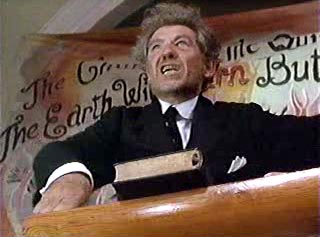 |
| Ye're all damned! |
“Jesus
said, "I came to bring fire to the earth, and how I wish it were
already kindled! I have a baptism with which to be baptized, and what
stress I am under until it is completed! Do you think that I have
come to bring peace to the earth? No, I tell you, but rather
division!”
This is one of Jesus' so called 'hard sayings;' sayings that are difficult or unpleasant to hear. This saying almost seems out of Character for Jesus. This is not gentle Jesus meek and mild, but a frightening Jesus mean and wild.These are not the sayings we expect from the prince of peace, and they are a thousand miles away from the comforting religion that we all enjoy and like to turn to in a crisis, all pastel colors and dewy eyed saints.
Or
maybe I shouldn't presume – there are in fact some of us who enjoy
these sayings, and preachers who get a perhaps not totally wholesome
thrill from preaching on these hard sayings; preachers who love
getting a rise from their congregations by preaching hell fire and
damnation, and congregations who love hearing it. The comic film
Cold Comfort Farm, based on a
novel by the same name, presents a delightful and stinging parody of
this kind of gleeful anger in preaching.
The
character Amos, played by Sir Ian McKellen, is a farmer in the English
country side in the 1930s who also serves as the minister of a tiny
church, known as the “Church of the Quivering Brethren.” When
asked by his well meaning cousin Flora what he will be preaching
about on Sunday, he explains in his thick north English accent that
he never prepares his sermons beforehand, but “I allus' know it
will be summat about burnin'... or the eternal torment... or sinners
comin' to judgment.” Amos then adds, just for good measure: “and
ye'll burn with the lot of them.” I highly recommend going on
youtube to see Ian Mckellen's rendition of this sermon to get the
full effect. When Amos preaches he takes no end of pleasure
describing each item in a catalog of hell's torments – perhaps
the strangest, and in context the most comic, of which is his loud
declaration that “There'll be no butter in hell!”. His
congregation listens and cheers him on, taking no end of delight in
hearing him declare with total assurance “Ye'll all burn!”
Well,
I am not particularly that kind of preacher. I don't think you're
particularly that kind of congregation. I would far rather talk
about God's grace and mercy, met in Christ and about reconcilliation,
new life and peace, than about fire from heaven and division. But
both are in the gospel, both are revealed by God and an honest
preacher is bound to preach both. So while I am not going to
describe any of the pains of hell in detail, I am going to suggest
that perhaps you will all
burn, and perhaps it is good news that you will.
How can fire, and division be good news? What does Jesus even mean by “bringing fire on the earth?” That's not as easy a question to answer as it might seem, but I think that it is safe to say that this is first of all an image of God's judgment. This saying comes at the end of a long passage rebuking hypocrites and self confident sinners. It draws on a long history of biblical images of judgment, from Sodom and Gommorah destroyed by fire from heaven, to the prophets who said “who can endure the day of [the Lord's] coming, and who can stand when he appears? For he is like a refiner's fire and like fullers' soap” (Mal 3. 1-2), or John the Baptist declaring that the Messiah will “burn the chaff with unquenchable fire.”
The
prophets and the psalms expected this judgment and they even looked
forward to it. They understood that the judgment itself was good
news, because God's judgment puts all things right. We often do not
like to think of God as judgmental, but that is a bit short sighted.
There are many things in this world that need to be judged.
When the innocent are hurt, when children are abused by those they
trust, when someone is punished for the color of their skin, when our
leaders lie to us, or when we discover that a friend is dying of
cancer... these things cry out for judgment.
When
a wildfire sweeps through, it clears away everything dead, the brush
and debris that have piled up. In areas that are prone to fire, there
will sometimes be intentional controlled fires, litt to clear away
debris. God's judgment is a fire like that, dividing what is dead
from what is alive. That kind of judgment is good news. Of course,
it looks like much better news when you think that its someone else
who will be judged; when you feel like you and your loved ones are
the ones who will be acquitted.
But
the better we come to know God and come to know ourselves, the more
we come to realize that we are not totally safe. There are weeds,
dead things, selfish motives, cruelties and lusts in our hearts. When
we realize that the fire is at our own door, it becomes much more
frightening. Remember that in the context where Jesus is speaking,
he is preaching to a lot of people – perhaps even some among his
disciples – who feel very confident in their own righteousness,
people who assume that God's judgment will not come near them. These
are the people Jesus calls hypocrites.
Now,
if this were a typical hell fire sermon, I would tell you about now,
how you are all liable to judgment, but how you can escape it by
getting your act together. I'm not going to do that though, because
I don't think that would be quite true to the words of the gospel.
Jesus does not promise to his disciples that they will escape the
fire that he has come to cast on the earth. On the contrary, they
will experience suffering, and “five
in one household will be divided, three against two and two against
three; they will be divided:
father
against son and
son against father, mother against daughter and daughter against
mother.”
Jesus
is not interested here in making it easy to follow him, and this
passage sounds like altogether bad news if we get right down to it.
And it would be, except for one fact, the fact that there is
something worse than experiencing the fire of God's judgment. That,
of course, is not experiencing God's judgment. I suppose God could
have decided not to bring judgement on the world. But where would
that leave us? It would leave us with all the same dead things in
the world and in our own hearts, the greed, the selfishness the
anger, the violence and the cruelty. It would leave us dead
ourselves.
Most
serious diseases hurt when they are being healed. Undergoing
treatment for cancer is a horrifying prospect, and no one would ever
choose that, if it were not that the alternative is death. The cure
for sin hurts too, but it is the way that God has provided for us to
find life. We may have to be divided from many things that we love,
from having our own way, from possessions from our images of
ourselves. It may mean that we are divided and cut off from our
communities, even from family and friends when our relationships with
them have become deadly to us and to them. This is painful, and it
burns, but it is the way that God has provided to lead us into life.
It
is a way that Jesus Christ has walked before us. He has shown and
carried the full weight of our judgment on the cross. He has also
shown that this judgment leads to resurrection. But the only way is
through fire, through division, through the cross. Perhaps there is
another way. Perhaps we don't need to go through fire – perhaps if
we really want it, God will simply let us stay as we are. He will
simply say, “Depart from me, I never knew you,” and give us a
little space to go away and let our weeds grow uninterrupted by fire,
till they choke us. I hope not though. I hope instead, that even if
I understand the words a little differently than he did the
fictional preacher I mentioned earlier was right, and that we'll all
burn.
In
the name...
Sunday, July 21, 2013
Ordination to the Sacred Presbyterate
Yesterday, at 10 am I was ordained to the sacred order of Pesbyters (Priests) in Christ's one, holy, catholic and apostolic Church by the Rt. Rev. William Love, IX Bishop of Albany. I celebrated for the first time today, a votive mass of the Holy Spirit.


Tuesday, June 11, 2013
Optimistic Thought on Anglican Division.
 |
| Western Rite Orthodox Priest from Western Rite Orthodoxy |
Maybe its because the Sun is shining after long days of winter (which were not that long ago in the Upstate NY), but I'm feeling uncharacteristically optimistic today - perhaps even unrealistically optimistic. I have been reflecting on some Anglican news items recently, especially in connection with the Roman Catholic and Orthodox Churches.
The Roman Catholics, of course, have invited Anglicans to join the Ordinariates. Anglican priests joining an Ordinariate can become Roman Catholic priests, even if married, and can retain significant parts of the Anglican liturgical tradition - that which is vaguely called the "Anglican Patrimony." I have posted before about the Ordinariate, and though I don't have any particular desire to join it myself, I think the Ordinariate is a good thing.
In the Orthodox churches, as well, there are Western Rite Orthodox parishes. The Western Rite Orthodox are in full communion with the Eastern Orthodox, but use some form of Western liturgy. Some use the Tridentine Mass, translated into the appropriate locale tongue and adapted slightly to fit more with Orthodox Eucharistic Theology. Others use a modified form of the Anglican liturgy, referred to as the Liturgy of St. Tikhon.
The Western Rite has always been a small group. As far as I know, in the US the only Orthodox jurisdictions that have Western Rite 'vicarates' are the Antiochian Orthodox and the Russian Orthodox Church Outside of Russia (ROCOR). However, talking with a few people involved with the ROCOR vicarate.
Meanwhile, of course, we have ACNA/ GAFCON and the Continuing Anglican churches which are still moving forward. The Continuum always seems to have struggled, but if you stalk Continuum blogs, as I do from time, you can find some evidence of renewal and growing unity among the members. ACNA, despite its instabilities as a newly formed ecclesial body really does seem to have a sense of mission, and is growing.
And of course, the old Canterbury communion still goes on.
I have long been of the Michael Ramsey school of thought on Anglican identity, i.e., Anglicanism exists in part to put itself out of business. I think Anglicanism has a certain ecumenical mission, the mission of forming some kind of bridge between broken and fragmented parts of the Body of Christ. The current state of affairs makes it easy to throw up our hands in despair, to decide that if Anglicans have failed to accomplish unity among ourselves, how can we possibly contribute to the unity of the wider body?
And maybe we have failed. Maybe our divisions are fatal. On the other hand Anglicanism isn't exactly disappearing with all these divisions - in a strange way it is flourishing, with little Anglican groups popping up all over the place. So here is my optimistic thought: Perhaps Anglicans are not only being divided but dispersed, and perhaps it is by being dispersed that we will serve the end of Christian unity. When I have attended Mass at Ordinariate churches, I have had a clear sense that I was worshiping with fellow Anglicans. There was a sense of communion, that we were somehow of one faith - in a way and to a degree that I have never felt in any other Roman Catholic Church.
That is a terribly subjective thing, and I am not attempting to base an argument on my emotional experience of worship. In a way, I am not trying to make an argument, just to suggest a line of thought. I cannot be the only Episcopalian who finds that when I go to a Western Rite Parish, or an Ordinariate Parish, or an ACNA parish, I am encountering my fellow Anglicans. Perhaps the scattered Anglican groups provide points of contact between various churches, a point where communion seems like a real possibility and the boundaries between (for example) Roman Catholics and Anglicans are particularly permeable.
It remains to be seen, of course, how the Holy Spirit will employ Anglicanism in the life of the wider Church, and I may be way off, but I see this as a possibility, and a hopeful one.
And of course, the old Canterbury communion still goes on.
 |
| Worship at Blessed JH Newman Ordinariate Community. From The Anglican Patrimony Blog |
I have long been of the Michael Ramsey school of thought on Anglican identity, i.e., Anglicanism exists in part to put itself out of business. I think Anglicanism has a certain ecumenical mission, the mission of forming some kind of bridge between broken and fragmented parts of the Body of Christ. The current state of affairs makes it easy to throw up our hands in despair, to decide that if Anglicans have failed to accomplish unity among ourselves, how can we possibly contribute to the unity of the wider body?
And maybe we have failed. Maybe our divisions are fatal. On the other hand Anglicanism isn't exactly disappearing with all these divisions - in a strange way it is flourishing, with little Anglican groups popping up all over the place. So here is my optimistic thought: Perhaps Anglicans are not only being divided but dispersed, and perhaps it is by being dispersed that we will serve the end of Christian unity. When I have attended Mass at Ordinariate churches, I have had a clear sense that I was worshiping with fellow Anglicans. There was a sense of communion, that we were somehow of one faith - in a way and to a degree that I have never felt in any other Roman Catholic Church.
That is a terribly subjective thing, and I am not attempting to base an argument on my emotional experience of worship. In a way, I am not trying to make an argument, just to suggest a line of thought. I cannot be the only Episcopalian who finds that when I go to a Western Rite Parish, or an Ordinariate Parish, or an ACNA parish, I am encountering my fellow Anglicans. Perhaps the scattered Anglican groups provide points of contact between various churches, a point where communion seems like a real possibility and the boundaries between (for example) Roman Catholics and Anglicans are particularly permeable.
It remains to be seen, of course, how the Holy Spirit will employ Anglicanism in the life of the wider Church, and I may be way off, but I see this as a possibility, and a hopeful one.
Monday, May 27, 2013
Some thoughts about the Boy Scouts
After decades of pressure the Boy Scouts have modified their position on the involvement of gays in scouting. This could hardly be called unexpected, any more than the polarized reactions were unexpected. Former Scouts who have since come out of the closet are overjoyed and conservatives are decrying this as the end of the BSA. The reactions are so predictable and stereotypical as to seem almost scripted. Conservatives and Liberals know their lines.
I haven't got a stake in the matter, myself. Although I was a cub scout, I simply fell away from scouting early on due to moving across the country and never finding a new troop I liked; it was a good but very brief part of my childhood. On the other hand, I can see why people for whom it was a formative and important part of growing up would care deeply about this decision. My own interest in the matter is fairly abstracted, but I think it is worth commenting on.
I can't say I totally side with either camp in terms of reaction, but overall I think the decision of the BSA in this case was the right one. I can see how this could mark a shift in the culture of scouting, toward a more permissive attitude toward sexual morals in general. This would be a sad thing. Of course, many conservatives regard this whole revision of the standards of membership as itself a loosening of morals.
For example at the Roman Catholic publication Crisis Magazine, Robert P. Reilly says this
The boy scouts have not set about to endorse homosexual inclinations as 'legitimate.' The new policy states simply that "No youth may be denied membership in the Boy Scouts of America on the basis of sexual orientation or preference alone." The membership standards before revision said "we do not grant membership to individuals who are open or avowed homosexuals or who engage in behavior that would become a distraction to the mission of the BSA." In other words, the only thing that has actually changed in terms of the written policy is that Boy Scouts may be open about their sexual inclinations. And inclinations, as conservatives regularly have to point out when discussing this issue, are not the same as actions. The distinction between orientation and action is also one that the Roman Catholic Church itself has also made quite clearly and consistently since the document Persona Humana published in 1975.
The ban on"open homosexuals" (whatever that means) from membership may have sent a message that the BSA stands for traditional morality. It also sent a message to young same sex attracted men that they should be ashamed and hide an incredibly painful struggle from what is probably their closest group of friends.
It needs to be said that not everyone who is "an open homosexual" is an active homosexual. What about Gregg Webb, a contributor to the blog Spiritual Friendship and is a self described celibate gay Christian and an Eagle Scout. Mr. Webb, as he notes in a recent article, did not come out or discuss his struggles until after he had become an Eagle Scout - but when he did discuss it, it was with friends from his Scouting days.
Although it will prove problematic in some ways, what the BSA has done with its policy change is not to endorse homosexual inclinations, far less homosexual actions. It has simply decided not to demand that members stay in the closet. Should this really be cause for outrage among conservative Christians? Is our message to gay people really nothing more than: "you might have these desires, but for God's sake have the decency not to tell anybody about it!" Is that really the good news that Christ offers to gays, lesbians and bisexuals? Surely we ought to be seeking to create spaces where people can be open and honest, and free to speak in the light of Christ's grace - not places where people are kept strictly in line by shame.
Further Reading:
New York Times Article on the BSA policy change.
BSA Membership Standards.
Scouts Honor: Ron Belgau at Spiritual Friendship on this story.
I haven't got a stake in the matter, myself. Although I was a cub scout, I simply fell away from scouting early on due to moving across the country and never finding a new troop I liked; it was a good but very brief part of my childhood. On the other hand, I can see why people for whom it was a formative and important part of growing up would care deeply about this decision. My own interest in the matter is fairly abstracted, but I think it is worth commenting on.
I can't say I totally side with either camp in terms of reaction, but overall I think the decision of the BSA in this case was the right one. I can see how this could mark a shift in the culture of scouting, toward a more permissive attitude toward sexual morals in general. This would be a sad thing. Of course, many conservatives regard this whole revision of the standards of membership as itself a loosening of morals.
For example at the Roman Catholic publication Crisis Magazine, Robert P. Reilly says this
By now accepting openly homosexual members, the Boy Scouts are... implicitly accepting the rationalization for homosexual sexual behavior as part of its moral formation It is avoiding doing this explicitly by continuing to insist on chastity from its Scouts in its policy that that “any sexual conduct, whether heterosexual or homosexual, by youth of Scouting age is contrary to the virtues of Scouting.”... if it [the BSA] is accepting the homosexual inclination as legitimate, what then could be wrong with the thing toward which it is inclined, meaning homosexual behavior?I don't want to pick on this article, and only present it as fairly exemplary. I can even see the point that Mr. Reilly is making, but I don't agree.
The boy scouts have not set about to endorse homosexual inclinations as 'legitimate.' The new policy states simply that "No youth may be denied membership in the Boy Scouts of America on the basis of sexual orientation or preference alone." The membership standards before revision said "we do not grant membership to individuals who are open or avowed homosexuals or who engage in behavior that would become a distraction to the mission of the BSA." In other words, the only thing that has actually changed in terms of the written policy is that Boy Scouts may be open about their sexual inclinations. And inclinations, as conservatives regularly have to point out when discussing this issue, are not the same as actions. The distinction between orientation and action is also one that the Roman Catholic Church itself has also made quite clearly and consistently since the document Persona Humana published in 1975.
The ban on"open homosexuals" (whatever that means) from membership may have sent a message that the BSA stands for traditional morality. It also sent a message to young same sex attracted men that they should be ashamed and hide an incredibly painful struggle from what is probably their closest group of friends.
It needs to be said that not everyone who is "an open homosexual" is an active homosexual. What about Gregg Webb, a contributor to the blog Spiritual Friendship and is a self described celibate gay Christian and an Eagle Scout. Mr. Webb, as he notes in a recent article, did not come out or discuss his struggles until after he had become an Eagle Scout - but when he did discuss it, it was with friends from his Scouting days.
While I didn't know about the policy [against openly homosexual scouts] at the time, if I had shared my struggle with homosexuality just a few years sooner, I could have been kicked out before I completed my Eagle Scout rank... It saddens me that the current policy denies boys the opportunities and experiences I had as part of the Boy Scouts, simply because of unchosen sexual attractions. It also sets up a culture of fear and dishonesty, and encourages boys to remain silent or to lie about their sexuality. The average age of a boy coming out about his homosexuality is in the mid teens. This is the most crucially formative time of involvement in scouts and the current policy forces any questioning youth to choose between being honest or being a scout. (Emphasis added)Under the old BSA membership standards, Gregg Webb and any other young men like him (of whom I feel certain there are many) would have been removed simply on the basis of being honest about his desires. Not for acting on his desires, not for promoting gay rights, just for being honest. This is unjust, and as he says it "sets up a culture of fear and dishonesty." I can't imagine that's what the Scouts want to be. After all "A Scout is trustworthy..."
Although it will prove problematic in some ways, what the BSA has done with its policy change is not to endorse homosexual inclinations, far less homosexual actions. It has simply decided not to demand that members stay in the closet. Should this really be cause for outrage among conservative Christians? Is our message to gay people really nothing more than: "you might have these desires, but for God's sake have the decency not to tell anybody about it!" Is that really the good news that Christ offers to gays, lesbians and bisexuals? Surely we ought to be seeking to create spaces where people can be open and honest, and free to speak in the light of Christ's grace - not places where people are kept strictly in line by shame.
Further Reading:
New York Times Article on the BSA policy change.
BSA Membership Standards.
Scouts Honor: Ron Belgau at Spiritual Friendship on this story.
Subscribe to:
Posts (Atom)