I can't even tell you how happy this makes me...
if you don't get it, go read more Calvin and Hobbes.
Tuesday, December 20, 2011

Monday, December 12, 2011
All Things Upside Down, or Men, Women and The Magnificat

At the moment, I should really be writing something more directly connected with the overwhelming number of final papers I need to hand in next week - but a man can only spend so much time checking the formatting of his footnotes before he needs a break.
I continue on my Auden kick, and I am reading through For the Time Being his extended poem written in the form of a Christmas oratorio. I figure it's good preparation for Christmas.
Reading that poem, together with this excellent post over at Without A Map, and some personal conversations with the wonderful author of that blog, has got me thinking again about the really extraordinary role of Mary in the history of Salvation.
One of the most striking passages so far is the "Temptation of St. Joseph."
The words of the 'Narrator' are a really amazing meditation on the relationship between Mary and Joseph, and the relationship between Men and Women generally.
The temptation of St. Joseph was the temptation to doubt Mary's fidelity when he discovered that she was pregnant, and to divorce her. In Eastern icons of the nativity, there is often an image of St. Joseph in the corner, conversing with an old man who represents the devil. Somehow, Joseph overcame his doubts, and did not send Mary away. I'm sure that God sending Gabriel (who probably got more work in this one six month period around 4 BC than he had since the book of Daniel) to drop him a line helped with this. Anyway, all of that is just by way of background. Here's what Mr. Auden has to say.
For the perpetual excuseAuden focuses in on something that is present in the gospel narratives, but which is, at least in my experience, rarely commented on. Mary is often presented as a meek and passive figure, the essence of some kind of idealized femininity. But this, it seems to me, is hardly biblical. Mary is passive in a certain sense - the incarnation was God's initiative, obviously, but Mary's willingness to participate in the whole plan was not a passive decision in the sense that she just sat there and watched things happen. She took it upon herself to endure outrageous difficulty, to be the bearer of the eternal word of God - to risk being the object of mockery and outcast. She even risked her life - Joseph could have had her stoned. Mary became the protagonist and hero of this small story within the wider gospel narrative.
Of Adam for his fall - "My little Eve,
God bless her, did beguile me and I ate,"
For his insistence on a nurse,
All service breast and lap, for giving Fate
Feminine gender to make Girls believe
That they can save him, you must now atone,
Joseph in silence and alone
While she who loves you makes you shake with fright,
Your love for her must tuck you up and kiss goodnight.
For likening Love to war, for all
The pay-off lines of limericks in which
The weak resentful bar-fly shows his sting,
For talking of their spiritual
Beauty to chorus girls, for flattering
The features of old gorgons who are rich,
For the impudent grin and Irish charm
That hides a cold will to do harm,
Today the roles are altered; you must be The Weaker Sex whose passion is passivity.
And Mary seems to have known that God was working in her, and turning all things upside down. I say she seems to have known it, because the Magnificat, her own hymn, is full of this imagery.
My soul doth magnify the Lord,The Magnificat is not the hymn of passive femininity - it is a battle hymn. The whole theme of it is that God has chosen the weak, the poor, the foolish things of this world as the instruments of his salvation. Ultimately, of course, we see this reversal in the cross, where the death of Christ, becomes his victory. In God's plan it is the weak and the poor who will be exalted, the slaves who will save the masters, and the woman who will save the man.
and my spirit hath rejoiced in God my Savior.
For he hath regarded
the lowliness of his handmaiden.
For behold from henceforth
all generations shall call me blessed.
For he that is mighty hath magnified me,
and holy is his Name.
And his mercy is on them that fear him
throughout all generations.
He hath showed strength with his arm;
he hath scattered the proud in the imagination of their hearts.
He hath put down the mighty from their seat,
and hath exalted the humble and meek.
He hath filled the hungry with good things,
and the rich he hath sent empty away.
He remembering his mercy hath holpen his servant Israel,
as he promised to our forefathers,
Abraham and his seed for ever.
Mary herself is a remarkable instance of this kind of reversal. She describes her self as "a handmaiden" - a female slave. And in that society, there really wasn't a lower rank than a female slave. Mary was poor, obscure, and a woman, and after God made her the mother of his Son, a woman who was regarded as an adulteress.
She was the lowest of the low, but God made her, after her son, the most important player in the whole drama of salvation. Mary, the obscure Jewish girl, is in the words of the Eastern hymn, the "Champion Leader" of the Church. Joseph has a part to play in all this, of course, but it is not the role of leader. He is the passive one, the man who must stand by and be the servant to his wife and the child she carried.
So what does that mean? I don't know exactly. The gospel turns everything upside down - especially human power structures, and that includes gender roles. I don't think that men and women are interchangeable, and I think there are real differences between the sexes which go beyond the obvious and merely physical. For the sake of full disclosure, I should admit that I am even ambivalent about Women's ordination. Still, no anthropology can claim to be Christian if it privileges men over women, or ignores the fact that in the gospel there is an inherent critique of gender roles.
I am not going to attempt here to come up with an anthropology that does justice to the biblical picture of men and women. Plainly, it is a big topic, and it raises all sorts of issues in the life of the Church (Women's ordination being the most obvious), so for now, I am just going to be content to raise the issue, and welcome thoughts and comments.
Tuesday, December 6, 2011
The Incompleteness of Anglicanism
 Archbishop Michael Ramsey, 100th Archbishop of Canterbury, is certainly one of the patron saints around here, even if his picture isn't up on the side bar.
His book, The Christian Priest Today, has been an important book for me in considering my own sense of calling. He was also another "Barthian Catholic," which is one of the descriptors I would use for myself these days.
This year, I have had several opportunities to dip into his classic book, The Gospel and The Catholic Church. I was really prepared for it by reading Eastern Orthodox ecclesiology - thinkers like Zizioulas, Dumitru Stăniloae and Thomas Hopko - and have discovered that Ramsey speaks especially to many of my own concerns, with his dual commitment to Ecumenism and to the Catholic order of the Church.
Here is what Lord Ramsey had to say about the place of Anglicanism in the broader Church.
While the Anglican church is vindicated by its place in history, with a strikingly balanced witness to the Gospel and the Church, its greater vindication lies in its pointing through its own history, to something of which it is a fragment. Its credentials are its incompleteness.Anglicanism is a mess, and it always has been. It is broken, but its brokenness also points to its vocation. What Anglicanism has to offer the wider Church is not just a slightly more liberal Catholicism, or a slightly more liturgical Evangelicalism. Rather, Anglicanism's gift is its peculiar witness to both the unity and the brokenness of the Church, and to the final hope that all who confess Christ may one day be one. And Anglicanism has the potential to stand as an authentic via media between Catholicism and Protestantism, not as a compromise, but as a bridge, calling the whole Church into a greater realization of the unity we have in Christ.
Saturday, December 3, 2011
Advent Poetry
I am on a W. H. Auden kick after having seen Allan Bennett's The Habit of Art, about Auden and Benjamin Britten, performed recently. So to celebrate Advent, here is an excerpt from the Advent section of his poem, "For the Time Being."
Alone, alone, about a dreadful wood
Of conscious evil runs a lost mankind,
Dreading to find its Father lest it find
The Goodness it has dreaded is not good:
Alone, alone, about our dreadful wood.Where is that Law for which we broke our own,
Where now that Justice for which Flesh resigned
Her hereditary right to passion, Mind
His will to absolute power? Gone. Gone.
Where is that Law for which we broke our own?The Pilgrim Way has led to the Abyss.
Was it to meet such grinning evidence
We left our richly odoured ignorance?
Was the triumphant answer to be this?
The Pilgrim Way has led to the Abyss.We who must die demand a miracle.
How could the Eternal do a temporal act,
The Infinite become a finite fact?
Nothing can save us that is possible:
We who must die demand a miracle.
Friday, December 2, 2011
The Internet is for Platonists
 *WARNING: This post is really just a series of random thoughts. Do not attempt to extract a thesis from it*
 I do not have the nerve to even hazard a guess at how many hours I spend online each week. It is doubtless vastly accelerating the progress of myopia, and for some reason it really bothers me to think about how much of my time is spent in the company of my decrepit iBook G4 (This little trooper has lasted since before Mac started using Intel).
Now, don't get me wrong, I love the internet and technology and all that, and if Facebook, Blogger, Gmail, and the archives over at First things disappeared tomorrow, I would be in a very bad mood. On the other hand, I might get more actual work done.
I have just been thinking recently, how the internet, and electronic media have transformed the idea of place. Not so long ago, your life and interests were confined to a relatively small geographical area. Now, much of my social interaction, on a daily basis, is with people on the other side of the country. If I were a teeny bit more cosmopolitan, it would include people on the other side of the globe. There is something bizarrely disincarnate about the internet. It takes flesh and blood people and turns them into pixels and information. I wonder, how will this effect our theology in the next few generations? It seems to me like it might exert a pressure in a generally idealist direction. What will it do to our whole notion of place? I tend to be sympathetic to the Eucharistic ecclesiology of Eastern thinkers like Zizioulas, but place plays an essential role in that ecclesiological scheme, with the bishop understood as the head of the Church in a given place. What does place even mean anymore for most of us? If the most important parts of our life are not lived within the limits of a physical place, does it make sense that the Church's structure should be determined by those limits? Why not have dioceses determined by affinity, as the ACNA seems to be doing for the most part? But then, does the concept of a diocese become evacuated of its real meaning? These are not, I think, merely academic questions. They seem to me to be highly relevant to a number of churches, most notably the emerging ACNA, but also the Orthodox churches in this country, as they continue their task of trying to achieve a unified Orthodox church.
All this just because I spend too flippin' much time on Facebook.
Maybe I'm crazy, I don't know, but the medium is the message and all that...
Thursday, December 1, 2011
Memento Mori
I am really pleased, generally speaking, that we wear white for requiems these days, what with Christ having trampled down death by death... still, I have to admit, old black requiem vestments are among the coolest looking pieces of religious garb. I just can't resist posting a link to these images of a high mass set from Daniel Mitsui's blog. The set is from Chimay, the abbey much beloved of beer drinkers everywhere (mmmm... Chimay).
As a note, Mr. Mitsui is doing a delightfully bleak series of posts (perhaps for the penitential season of Advent) on Christian art dealing with death, which I highly recommend. It appeals to my inner goth.
h/t: Eve Tushnet
As a note, Mr. Mitsui is doing a delightfully bleak series of posts (perhaps for the penitential season of Advent) on Christian art dealing with death, which I highly recommend. It appeals to my inner goth.
h/t: Eve Tushnet
Monday, October 31, 2011
The Hidden Reign of God and the Long Defeat
It has been a while since I posted, and I sincerely wish I had more time to post on the blog. I am afraid this semester has been a bit overwhelming, though, so I can't promise that posts will become more frequent until winter break rolls around. I do have some substantive posts in the works, which I hope to be able to work on in the next month, but we will just have to see. In the mean time, here is a sermon I preached yesterday at the church plant where I am blessed to be doing my field work. It is not my best work, stylistically speaking, but I am relatively happy with the content.
This sermon focuses on Revelation 5:1-11, and while there is a lot there, I chose to focus simply and directly on the message of the cross. It wasn't an 'evangelistic sermon,' but the more I think about preaching, and the more I try to live the Christian life, also the more convinced I become that it is vital to keep preaching the gospel to Christians. We never stop needing the word of the cross.
 The book of Revelation is an amazingly popular book of the Bible. There are an amazing number of movies made based on the book of Revelation, or using images from the book of Revelation. Everybody knows that 666 is the number of the beast, or has heard of the four horsemen of the apocalypse, even outside the Christian church. Inside the Church, everybody has an opinion on how to interpret revelation, and the timeline for the end of the world.
There are some denominations where they spend a lot of time reading Revelation, so a lot of you are probably pretty familiar with the book if you are from one of those denominations. I, however, grew up an Anglican, and the truth is, Anglicans are kind of nervous about Revelation. We read it, but we don’t talk about it much. Which means, I can’t claim to really understand the book of Revelation. I’m even a little intimidated by it, as a preacher. It’s confusing, its filled with monsters that sound like something out of a Godzilla Movie, and it’s tempting to get bogged down in explaining what each head on each monster, or each jewel on God’s throne signifies. For example: Just who are these twenty four elders? What are the four living creatures with eyes “within and without,” and what does that even look like? Or what does any of this have to do with the Left Behind series, the Soviet Union or who ever it is we’ve decided is the Anti-Christ this week?
Now I have my own theories about the end times, and I could tell you about them, but I’m not going to do that. I think with Revelation, the best course is to begin with the big picture, with the obvious things that God is saying. So I am going to set aside all the detailed questions, and try to preach a very simple sermon on Revelation 5. So what is going on in this part of Revelation? In the first three chapters, John records a series of letters to series of letters to seven Churches, recording messages to them from the risen Christ, when he is caught up into heaven.
And it is there that he sees the vision of the Lamb who was slain. And this vision needs to be set in some context. John is called up into heaven, through an open door, and the scene that he meets in heaven is the throne of God, surrounded by all the host of heaven - most notably the twenty four elders with golden crowns, four living creatures with eyes all over, and uncountable Angels as well. There are a lot of interpretations of what these figures mean, but what I find most convincing is the view that the elders represent all the redeemed people of God, and the living creatures represent his rule over all of creation.
The image of God surrounded by these twenty four elders would have suggested the typical images of Caesar surrounded by kings, which is part of why this scene in God’s throne room is central to John’s vision. One of the overarching questions of the book of Revelation, maybe the overarching question, is who is really in charge? who reigns and is worthy of worship and honor? is it God or the forces of the world, like the dragon? The Beast? Or more concretely, Caesar and the Roman Empire?
We aren’t left in suspense. From the beginning the answer is clear: it is God who reigns, and God who rules over time and history and the whole world. It is God who sits enthroned, and who is worthy to receive honor and glory, because it is God who “Created all things and by his will they existed and were created” (Rev. 4:11). That’s the context we need to have before we can understand chapter 5. God reigns, and God is in control. This isn’t a statement about what will be, but a statement about how things are already. God already reigns, and already governs all things, despite all contrary evidence.
And their is abundant contrary evidence. An honest assessment of the world demands that we admit: it doesn’t look like God is in control. And St. John seems to have been completely aware of this. When we come to chapter 5, St. John sees that God, seated on his throne, is holding a scroll. The first thing we see in chapter 5 is a desperate search of the entire universe for someone who can open this scroll. When St. John realizes there is no one, no human being, animal or angel, who can open this scroll he starts to weep. Which, frankly, seems like kind of an over reaction. Why is this scroll so important?
Well,The scroll is another symbol that is disputed, but again, its basic meaning is pretty clear. Most of the book of Revelation is about what happens as each seal on the scroll is opened, and God’s rule and God’s judgments are enacted in history. What St. John, understood, somehow, was that if there was no one to open this scroll, then God doesn’t really rule in the world after all.
He talks about this search of heaven and earth in one sentence, but I think it must have taken a good deal of time; he probably doesn’t tell us what he saw, because we all know basically what there was to see. If we go looking for signs of God’s reign in the world, our search will be mostly disappointing. In this world There’s violence, wars and rumors of wars, injustice and corruption. We’ve already mentioned Caesar, who would have been an obvious enemy of God in John’s time, but there are still world leaders who have divine pretensions, who feel entitled to treat other people like they own them.
Even the natural world seems to be out of control. Think of all the people killed by disease, or those killed, randomly to all appearances, by natural disasters just this past year or so. The Tsunami in Japan, the earthquakes in Haiti and New Zealand, tornadoes and devastating heat in the Midwest.
Just to make it a little worse, it’s not as if being a Christian makes life much easier. And we all know that persecution continues to be a reality for Christians around the world. All of us at Trinity go to school with a number of student from Africa, who could tell you first hand about being persecuted for their faith.
Even if we don’t experience outright persecution, we all face pressure to turn away from Christ, and we can find plenty of other things to worship. We could worship the State; we could worship America, or some ideology, or we can just worship our appetites, and most of the media attempts to get us to do. When the last election happened, there were a lot of people who seemed to be worshiping one of the candidates. Or if we’re the pious sort, we could do something really dangerous like worshipping the Church, or even the liturgy.
But speaking for myself, and maybe for others as well, what I think I struggle with more than anything, isn’t any of these things. All of them are external. What really worries me is that Even when I look at myself, it is not always clear that God is in control. Our hearts are “deceitful... and desperately sick” as Jeremiah says, and even when we desire to do good we do evil, even after we come to faith in Christ. We all have the experience that St. Paul describes when he says “I do not do the good I want, but the evil I do not want is what I keep on doing” (Rom 7:19). When St. John went searching for someone who could open the scroll, and bring God’s rule in the world, he found no one. Not even the holiest of Saints, who could do it. So, whether we look at the world outside, or at the depths of our own hearts, God does not seem to rule.
Like St. John, If we look for God’s reign, we wont find it anywhere, unless we look to the cross. We only understand God’s rule and judgment when we realize that that they are exercised in the Lamb that was slain.
When the scroll in God’s hand is opened, both divine judgement and salvation are accomplished. In all the world, there is only one person who can open the scroll and exercise that divine authority: The Lion of Judah, who has conquered, and when we actually see the Lion of Judah, he is not what we expect - not a mighty conqueror, but a lamb, and a slaughtered lamb at that.
And it is precisely because of his sacrifice, his death, that Christ Jesus, the Lamb of God is qualified to open the scroll and to rule. Echoing their hymn to God seated on the throne the elders and the living creatures praise the lamb and say “Worthy are you to take the scroll and to open its seals, for you were slain, and by your blood you ransomed people for God” (5:4).
God’s ultimate act of authority in the world isn’t a show of force, as we might expect and hope, but instead it appears as a show of weakness. Because in the Cross, God actually judges all the evil that there is in the world. The judgement is that when the one really righteous person, when God himself comes into the world, our response as human beings was to kill him. St. John in his gospel says “This is the judgment: the Light has come into the world, and people loved darkness rather than the light...” (John 3:19). God has judged all of us in the cross of Christ. He has done more than that, though. He’s taken the judgment on himself. It was Jesus who bore the brunt of our punishment and our sin. And through faith, we have been let in the secret though, and we know that the cross leads to the Resurrection. The Lamb has been slain, but he has also been raised. God has judged Jesus, but he has also vindicated him, by raising him from the dead. And if we know that we have been Judged in Jesus, we also know that we have been vindicated and forgiven in him. “If we have died with Christ, we believe that we will also live with him” (Rom 8:6).
What does this mean for God’s people in the world then? First, it means that God really is in control, despite all the evidence, because God has already overcome sin and death in the cross. God does reign in the world, but he reigns from the cross. His reign is mostly hidden because that is the nature of the cross. God’s reign isn’t by force, but but by grace.
Secondly, it means that we have victory with God in Christ, but following our Lord, our victory is generally hidden. One of my favorite authors, J. R. R. Tolkien, once said “I am a Christian... so that I do not expect ‘history’ to be anything but a ‘long defeat’ — though it contains... some samples or glimpses of final victory.” This isn’t pessimism, but simply recognizing that most of our experience in this life is the experience of the cross, and that doesn’t mean that we are failing or that God has abandoned us. It may mean just the opposite, that we are being given the chance to witness to God’s victory in the Cross, and that God is very near to us.
And this is true even when we look at the state of our own souls. In fact, the closer we come to Christ, the more we will become aware of how inadequate we are, how little God seems to rule in our hearts and in our lives when we examine ourselves. The most sanctified people probably think the least of themselves, but then again, they also spend the least amount of time thinking of themselves. Because God calls us to repentance, which means to turn away from ourselves, and turn our eyes towards the cross. That’s precisely what our sanctification consists of; it’s not so much a matter of trying to sin a little less each day, or of trying to make ourselves a little better, but of constant repentance, turning away from ourselves and towards Christ.
even if we practice spiritual disciplines like fasting, or rules of prayer, they aren’t useful primarily because they make us better people, but because they make us realize how much we need God. They make us look away from ourselves and towards what Christ has done on the cross, and that is how we come to love God more. We don’t love God in the abstract, by just thinking about how good he is; we love the God who sent his only Son to die for you and for me. When we believe that, when we know it with all our hearts, our lives can’t help but be transformed.
Because when we look towards Christ, we see that God truly does reign, that he truly is worthy of glory and honor and praise. And like the Elders in John’s vision, we can only fall down in worship, offering our crowns back to the one who gave them to us in the first place.
In the Name of the + Father...
This sermon focuses on Revelation 5:1-11, and while there is a lot there, I chose to focus simply and directly on the message of the cross. It wasn't an 'evangelistic sermon,' but the more I think about preaching, and the more I try to live the Christian life, also the more convinced I become that it is vital to keep preaching the gospel to Christians. We never stop needing the word of the cross.
 The book of Revelation is an amazingly popular book of the Bible. There are an amazing number of movies made based on the book of Revelation, or using images from the book of Revelation. Everybody knows that 666 is the number of the beast, or has heard of the four horsemen of the apocalypse, even outside the Christian church. Inside the Church, everybody has an opinion on how to interpret revelation, and the timeline for the end of the world.
There are some denominations where they spend a lot of time reading Revelation, so a lot of you are probably pretty familiar with the book if you are from one of those denominations. I, however, grew up an Anglican, and the truth is, Anglicans are kind of nervous about Revelation. We read it, but we don’t talk about it much. Which means, I can’t claim to really understand the book of Revelation. I’m even a little intimidated by it, as a preacher. It’s confusing, its filled with monsters that sound like something out of a Godzilla Movie, and it’s tempting to get bogged down in explaining what each head on each monster, or each jewel on God’s throne signifies. For example: Just who are these twenty four elders? What are the four living creatures with eyes “within and without,” and what does that even look like? Or what does any of this have to do with the Left Behind series, the Soviet Union or who ever it is we’ve decided is the Anti-Christ this week?
Now I have my own theories about the end times, and I could tell you about them, but I’m not going to do that. I think with Revelation, the best course is to begin with the big picture, with the obvious things that God is saying. So I am going to set aside all the detailed questions, and try to preach a very simple sermon on Revelation 5. So what is going on in this part of Revelation? In the first three chapters, John records a series of letters to series of letters to seven Churches, recording messages to them from the risen Christ, when he is caught up into heaven.
And it is there that he sees the vision of the Lamb who was slain. And this vision needs to be set in some context. John is called up into heaven, through an open door, and the scene that he meets in heaven is the throne of God, surrounded by all the host of heaven - most notably the twenty four elders with golden crowns, four living creatures with eyes all over, and uncountable Angels as well. There are a lot of interpretations of what these figures mean, but what I find most convincing is the view that the elders represent all the redeemed people of God, and the living creatures represent his rule over all of creation.
The image of God surrounded by these twenty four elders would have suggested the typical images of Caesar surrounded by kings, which is part of why this scene in God’s throne room is central to John’s vision. One of the overarching questions of the book of Revelation, maybe the overarching question, is who is really in charge? who reigns and is worthy of worship and honor? is it God or the forces of the world, like the dragon? The Beast? Or more concretely, Caesar and the Roman Empire?
We aren’t left in suspense. From the beginning the answer is clear: it is God who reigns, and God who rules over time and history and the whole world. It is God who sits enthroned, and who is worthy to receive honor and glory, because it is God who “Created all things and by his will they existed and were created” (Rev. 4:11). That’s the context we need to have before we can understand chapter 5. God reigns, and God is in control. This isn’t a statement about what will be, but a statement about how things are already. God already reigns, and already governs all things, despite all contrary evidence.
And their is abundant contrary evidence. An honest assessment of the world demands that we admit: it doesn’t look like God is in control. And St. John seems to have been completely aware of this. When we come to chapter 5, St. John sees that God, seated on his throne, is holding a scroll. The first thing we see in chapter 5 is a desperate search of the entire universe for someone who can open this scroll. When St. John realizes there is no one, no human being, animal or angel, who can open this scroll he starts to weep. Which, frankly, seems like kind of an over reaction. Why is this scroll so important?
Well,The scroll is another symbol that is disputed, but again, its basic meaning is pretty clear. Most of the book of Revelation is about what happens as each seal on the scroll is opened, and God’s rule and God’s judgments are enacted in history. What St. John, understood, somehow, was that if there was no one to open this scroll, then God doesn’t really rule in the world after all.
He talks about this search of heaven and earth in one sentence, but I think it must have taken a good deal of time; he probably doesn’t tell us what he saw, because we all know basically what there was to see. If we go looking for signs of God’s reign in the world, our search will be mostly disappointing. In this world There’s violence, wars and rumors of wars, injustice and corruption. We’ve already mentioned Caesar, who would have been an obvious enemy of God in John’s time, but there are still world leaders who have divine pretensions, who feel entitled to treat other people like they own them.
Even the natural world seems to be out of control. Think of all the people killed by disease, or those killed, randomly to all appearances, by natural disasters just this past year or so. The Tsunami in Japan, the earthquakes in Haiti and New Zealand, tornadoes and devastating heat in the Midwest.
Just to make it a little worse, it’s not as if being a Christian makes life much easier. And we all know that persecution continues to be a reality for Christians around the world. All of us at Trinity go to school with a number of student from Africa, who could tell you first hand about being persecuted for their faith.
Even if we don’t experience outright persecution, we all face pressure to turn away from Christ, and we can find plenty of other things to worship. We could worship the State; we could worship America, or some ideology, or we can just worship our appetites, and most of the media attempts to get us to do. When the last election happened, there were a lot of people who seemed to be worshiping one of the candidates. Or if we’re the pious sort, we could do something really dangerous like worshipping the Church, or even the liturgy.
But speaking for myself, and maybe for others as well, what I think I struggle with more than anything, isn’t any of these things. All of them are external. What really worries me is that Even when I look at myself, it is not always clear that God is in control. Our hearts are “deceitful... and desperately sick” as Jeremiah says, and even when we desire to do good we do evil, even after we come to faith in Christ. We all have the experience that St. Paul describes when he says “I do not do the good I want, but the evil I do not want is what I keep on doing” (Rom 7:19). When St. John went searching for someone who could open the scroll, and bring God’s rule in the world, he found no one. Not even the holiest of Saints, who could do it. So, whether we look at the world outside, or at the depths of our own hearts, God does not seem to rule.
Like St. John, If we look for God’s reign, we wont find it anywhere, unless we look to the cross. We only understand God’s rule and judgment when we realize that that they are exercised in the Lamb that was slain.
When the scroll in God’s hand is opened, both divine judgement and salvation are accomplished. In all the world, there is only one person who can open the scroll and exercise that divine authority: The Lion of Judah, who has conquered, and when we actually see the Lion of Judah, he is not what we expect - not a mighty conqueror, but a lamb, and a slaughtered lamb at that.
And it is precisely because of his sacrifice, his death, that Christ Jesus, the Lamb of God is qualified to open the scroll and to rule. Echoing their hymn to God seated on the throne the elders and the living creatures praise the lamb and say “Worthy are you to take the scroll and to open its seals, for you were slain, and by your blood you ransomed people for God” (5:4).
God’s ultimate act of authority in the world isn’t a show of force, as we might expect and hope, but instead it appears as a show of weakness. Because in the Cross, God actually judges all the evil that there is in the world. The judgement is that when the one really righteous person, when God himself comes into the world, our response as human beings was to kill him. St. John in his gospel says “This is the judgment: the Light has come into the world, and people loved darkness rather than the light...” (John 3:19). God has judged all of us in the cross of Christ. He has done more than that, though. He’s taken the judgment on himself. It was Jesus who bore the brunt of our punishment and our sin. And through faith, we have been let in the secret though, and we know that the cross leads to the Resurrection. The Lamb has been slain, but he has also been raised. God has judged Jesus, but he has also vindicated him, by raising him from the dead. And if we know that we have been Judged in Jesus, we also know that we have been vindicated and forgiven in him. “If we have died with Christ, we believe that we will also live with him” (Rom 8:6).
What does this mean for God’s people in the world then? First, it means that God really is in control, despite all the evidence, because God has already overcome sin and death in the cross. God does reign in the world, but he reigns from the cross. His reign is mostly hidden because that is the nature of the cross. God’s reign isn’t by force, but but by grace.
Secondly, it means that we have victory with God in Christ, but following our Lord, our victory is generally hidden. One of my favorite authors, J. R. R. Tolkien, once said “I am a Christian... so that I do not expect ‘history’ to be anything but a ‘long defeat’ — though it contains... some samples or glimpses of final victory.” This isn’t pessimism, but simply recognizing that most of our experience in this life is the experience of the cross, and that doesn’t mean that we are failing or that God has abandoned us. It may mean just the opposite, that we are being given the chance to witness to God’s victory in the Cross, and that God is very near to us.
And this is true even when we look at the state of our own souls. In fact, the closer we come to Christ, the more we will become aware of how inadequate we are, how little God seems to rule in our hearts and in our lives when we examine ourselves. The most sanctified people probably think the least of themselves, but then again, they also spend the least amount of time thinking of themselves. Because God calls us to repentance, which means to turn away from ourselves, and turn our eyes towards the cross. That’s precisely what our sanctification consists of; it’s not so much a matter of trying to sin a little less each day, or of trying to make ourselves a little better, but of constant repentance, turning away from ourselves and towards Christ.
even if we practice spiritual disciplines like fasting, or rules of prayer, they aren’t useful primarily because they make us better people, but because they make us realize how much we need God. They make us look away from ourselves and towards what Christ has done on the cross, and that is how we come to love God more. We don’t love God in the abstract, by just thinking about how good he is; we love the God who sent his only Son to die for you and for me. When we believe that, when we know it with all our hearts, our lives can’t help but be transformed.
Because when we look towards Christ, we see that God truly does reign, that he truly is worthy of glory and honor and praise. And like the Elders in John’s vision, we can only fall down in worship, offering our crowns back to the one who gave them to us in the first place.
In the Name of the + Father...
Saturday, September 3, 2011
Trinitarian Reflections After a Zen Encounter (Part 2).
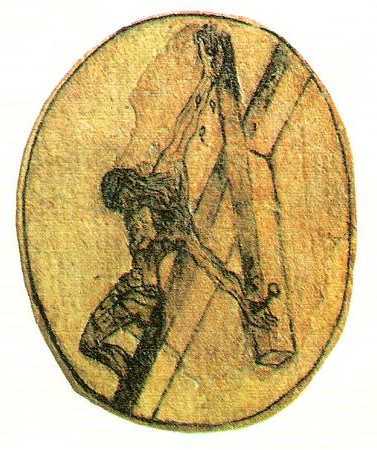
Well, here is my follow up to the post I wrote 2 months ago, entitled: "Trinitarian Reflections after a Zen Encounter (Part 1)," from about two months ago..This piece is very incomplete, and I still need to develop my thoughts on these issues more clearly, but I also thought I owed any one who is taking the time to read this blog a follow up my previous post. In the previous post, I focused on the incarnation, and discussed the sacraments, worship and the difference between the sacred and secular. The context for these discussions was a set of critical remarks I heard about Christianity, during an interfaith discussion group hosted by a Zen Temple. In this post, I try to focus more on the Trinity and outline some ways in which I think that a strongly Trinitarian spirituality can help us to approach Zen. I am not really saying much that is original here (at least I don't mean to),
In the previous post I mentioned two critiques of Christianity, and responded to the first. The second was as follows:
Christianity begins with the individual, and is primarily concerned with individual salvation. The starting point for Christians is: how can I as an individual escape the wrath to come? Asian religions generally, and Confucianism in particular, are far more oriented towards the group; family, city, nation, world, etc. The individual’s identity is derived from those around him. Christianity, therefore, is basically individualistic.My basic response is that the Trinity, which together with the Incarnation, is one of the central mysteries of Christianity, totally excludes individualism. It may be that there are individualistic Christians, but the Christian God is not a monad. Unlike Buddhism, Christianity teaches that God is personal, but God is not a single person, because such a being is finally unthinkable. To be a person is always to be in communion with other persons.
The practical meaning of this is that "individual salvation" is something of an oxymoron. As human beings we are made in the image of the Trinity, and so we can only be saved - in fact we can only really be human - by being in communion with others and with God. To be a human being fully alive we must pour out our lives in obedience and love to God, and service to our neighbors.
Fr. Thomas Hopko expresses this remarkably well in an article commenting on the command to "Love your neighbor as yourself."
So, “love your neighbor as yourself.” However, in certain modern editions of the Bible, I have seen this translated as, “You shall love your neighbor as you love yourself.” But that’s not what it says. The best English translation of that passage from Leviticus is, “You shall love your neighbor as being your own self.” Your neighbor is your true self. You have no self in yourself.The Christian life consists in emptying ourselves, in taking up our crosses daily and denying ourselves out of love for our neighbors. This is what we see in Christ's life, his offering up of himself to the Father, for the sake of humanity, and the foundation of the Christian life is the Trinity, in which the persons give themselves totally in love to the others. If this were not God's nature, then he would not be truly a God of love, and certainly he would not be the sort of God who went to the cross for the sake of his creatures.
An “individual” is a person who refuses to love. When a person refuses to identify in being and value with “the least,” even with “the enemy,” then the person becomes an individual, a self-enclosed being trying to have proper relationships — usually on his or her own terms. But again, we would say that the person only comes into existence by going out of oneself into communion with the other. So my task is not to decide whether or not I will be in relationship with you but to realize that I am in communion with you: my life is yours, and your life is mine. (From Living in Communion, available here. Emphasis mine)
What is surprising though is that this distinctly Christian understanding of reality resonates deeply with the Buddhist doctrine of Sunyata or Emptiness. There have been several excellent articles and books written on precisely this comparison. To my knowledge the best of these books is The Emptying God: A Buddhist-Jewish-Christian Dialogue with Masao Abe on God, Kenosis and Sunyata, edited by John B. Cobb, Jr. and Christopher Ives.
Buddha taught that "All beings are without a self." Everything which exists is "empty" or insubstantial. Buddha's teaching was specifically directed against the Hindu teaching of his day, which said that one could eventually reach the realization that the Atman, or self, is actually identical to Brahman, the ultimate reality (i.e., God). Buddha, in contrast, denied that there is any such thing as Atman which could be identified with ultimate reality.
Instead of having some core element of their being which is their "self" all beings exist only as part of a web of relations. So I am, because I am a son, a brother, a person living in a particular place (relationship to other objects in space) and time (relation to other objects as they change). As Raimundo Panikkar explains it
[A] person is a citizen with respect to the civitas a creature with respect to the Creator, and so on, but the very character, complexion, intelligence, will, and so on - any accidents that would seem to belong to this individual as "substance" - are actually nothing but relationships distinguishing this person from other similar groupings of attributes. (The Silence of God: The Answer of the Buddha. Maryknoll, NY: Orbis, 1990. 136-137)The Buddhist assertion is that there is nothing underlying these relationships, that is, there is no substance which has relationships to other substances, rather relationships constitute substances. Panikkar terms this "radical relativity." At the heart of all beings there is no stable foundation, no substance upon which accidents rest, but only Sunyata or emptiness. The Buddhist Heart Sutra succintly says "That which is form is emptiness, that which is emptiness form." Some interpreters take this to be a kind of Nihilism
But this is incorrect, because Sunyata does not indicate that everything is illusory or meaningless, but that all beings are interdependent, rather than self-sufficient and isolated. Further, Sunyata is not a mere nothingness or void. "In the realization of true Sunyata, form is ceaselessly emptied, turning into formless emptiness, and formless emptiness is ceaselessly emptied and forever freely taking form. This total dyamic movement of emptying, not a static state of emptiness, is the true meaning of Suyata" (Masao Abe. "Kenotic God and Dynamic Sunyata" in The Emptying God. 28). At least in theory, this understanding of Sunyata should not result in nihilism, but in compassion and openness to others, because part of what emptiness means is precisely self-negation for the sake of the other. In Mahayana Buddhism, the Bodhisattva even forgoes Nirvana for the sake of others.
Sunyata understood in this sense is not so far from the quote above from Fr. Hopko: "Your neighbor is your true self. You have no self in yourself." The true self is found only in communion, in giving our lives and ourselves for the sake of others. We are called to lay down our lives, which could certainly sound rather depressing and Nihilistic, but paradoxically Jesus says: "Truly, truly, I say to you, unless a grain of wheat falls into the earth and dies, it remains alone; but if it dies, it bears much fruit. Whoever loves his life loses it, and whoever hates his life in this world will keep it for eternal life" (John 12:24-25 ESV).
In other words, it is only through "emptying" ourselves that we can really come to live. Dying to ourselves, for Christians, does not entail a process of depersonalization, as in so many pagan mystical systems. Instead, by dying to ourselves, we actually become more ourselves. Christians learns this not from an experience of Sunyata, but through the Cross of Christ, and in the revelation of the Trinity.
In God, being is communion (apologies for stealing from John Zizioulas), and so our lives, too, are communion, and we only live in relation to others. Panikkar, in the work already cited, goes so far as to say "the Trinity is radical relativity par excellence" (The Silence of God. 141). Realizing of course, that Panikkar was not totally orthodox as a Christian thinker, I still think this point is rather helpful, because it shows clearly how much Christians can sympathize with the Buddhist understanding of Emptiness.
I will venture to say, therefore, that Christianity is able to embrace the insights of Buddhism on this point, because these same insights are also found in Christian tradition. I am not advocating syncretism, or coming up with some kind of Zen Christianity. Rather I am suggesting that the truths experienced by Buddhists are already present in Christian faith, that the Trinity both includes and surpasses the truth of Sunyata.
That is all I have to say for now, but I expect I will return to some of these ideas in later posts.
Tuesday, August 9, 2011
On the Road Again
Okay, I feel this is obligatory.
Well, now that's out of the way.
In any case, it has been a little bit since I posted up a substantial post, and I think it will be a few days before I write anything really solid for the blog; still, I wanted to give my good readers an update on my present whereabouts and activities. I am done with my internship, having preached one last time at St. James Church, Las Cruces this past Sunday.
The last two or three weeks of my internship were quite intense with lots to do, and some of it still to be done. I had to write a sermon, visit a church in El Paso, and get my apartment deep cleaned before leaving. Also, I had to finish putting my various projects in order, including finishing up the Altar Guild Manual, Customary and Pastoral Care Manual for St. James (I was revising the first two, and composing the last. Next year's intern will pick up where I left off).
I am still processing all the things that happened during the internship, but it was a really great experience, and I think it is one of the best things I have done for my formation as a seminarian so far.
I made new friends, and I learned a lot just from talking to different rectors, and even a couple of bishops, including Bishop Lamb, the retired Bishop of Northern California, who was serving as interim rector of one of the parishes I visited.
I was reminded numerous times during the internship of my weakness and God's strength, and I am very grateful for that.
It has also given me a lot to think about as I process what is going on in the Episcopal Church. I don't write about that much on this blog, mainly because I think there are plenty of Blogs that deal with TEC/ACNA politics already, and do a better job than I possibly could. I am, however, painfully aware of the storms raging within the Anglican Communion right now, and all of us within TEC have to deal with the present troubles as best we can.
I will say that the Diocese of the Rio Grande is much more liberal leaning than my home diocese of Albany, although I was in an evangelical parish. I have spent my whole life in conservative dioceses, so it was eye opening to talk with more liberal leaders. Amongst other things, it convinced me that most of the "two gospels" rhetoric which comes from conservative Anglicans, and which I have even employed from time to time, is overblown.
I will probably have more to say about that at length.
For now though, I am a bit to tired to right about such deep subjects. I set out from Las Cruces yesterday, and stayed in Albuquerque for the night. Right now, I am sitting in a Starbucks in Amarillo, TX. I am probably going to stay here (in Amarillo, not Starbucks) for the night , even though I would like to get further, but I am afraid I am just so tired that pushing myself would not be a good idea. Besides, there are not a lot of big cities between here and Oklahoma City, and I am not sure how long I would have to drive before I found a good motel. Anyway - more updates to follow.
Pax Tibi
Well, now that's out of the way.
In any case, it has been a little bit since I posted up a substantial post, and I think it will be a few days before I write anything really solid for the blog; still, I wanted to give my good readers an update on my present whereabouts and activities. I am done with my internship, having preached one last time at St. James Church, Las Cruces this past Sunday.
The last two or three weeks of my internship were quite intense with lots to do, and some of it still to be done. I had to write a sermon, visit a church in El Paso, and get my apartment deep cleaned before leaving. Also, I had to finish putting my various projects in order, including finishing up the Altar Guild Manual, Customary and Pastoral Care Manual for St. James (I was revising the first two, and composing the last. Next year's intern will pick up where I left off).
I am still processing all the things that happened during the internship, but it was a really great experience, and I think it is one of the best things I have done for my formation as a seminarian so far.
I made new friends, and I learned a lot just from talking to different rectors, and even a couple of bishops, including Bishop Lamb, the retired Bishop of Northern California, who was serving as interim rector of one of the parishes I visited.
I was reminded numerous times during the internship of my weakness and God's strength, and I am very grateful for that.
It has also given me a lot to think about as I process what is going on in the Episcopal Church. I don't write about that much on this blog, mainly because I think there are plenty of Blogs that deal with TEC/ACNA politics already, and do a better job than I possibly could. I am, however, painfully aware of the storms raging within the Anglican Communion right now, and all of us within TEC have to deal with the present troubles as best we can.
I will say that the Diocese of the Rio Grande is much more liberal leaning than my home diocese of Albany, although I was in an evangelical parish. I have spent my whole life in conservative dioceses, so it was eye opening to talk with more liberal leaders. Amongst other things, it convinced me that most of the "two gospels" rhetoric which comes from conservative Anglicans, and which I have even employed from time to time, is overblown.
I will probably have more to say about that at length.
For now though, I am a bit to tired to right about such deep subjects. I set out from Las Cruces yesterday, and stayed in Albuquerque for the night. Right now, I am sitting in a Starbucks in Amarillo, TX. I am probably going to stay here (in Amarillo, not Starbucks) for the night , even though I would like to get further, but I am afraid I am just so tired that pushing myself would not be a good idea. Besides, there are not a lot of big cities between here and Oklahoma City, and I am not sure how long I would have to drive before I found a good motel. Anyway - more updates to follow.
Pax Tibi
Thursday, August 4, 2011
Subscribe to:
Posts (Atom)